WolfUp Basketball Playbook
FIBA Rules Guide

FIBA 5-on-5 · Visual rules

See the space. Understand the whistle.

Skip the rulebook marathon. Six common scenes explain throw-ins, screens, three seconds and the calls players meet most.

Currently applicable: FIBA 2024 rules · Checked 24 Jul 2026

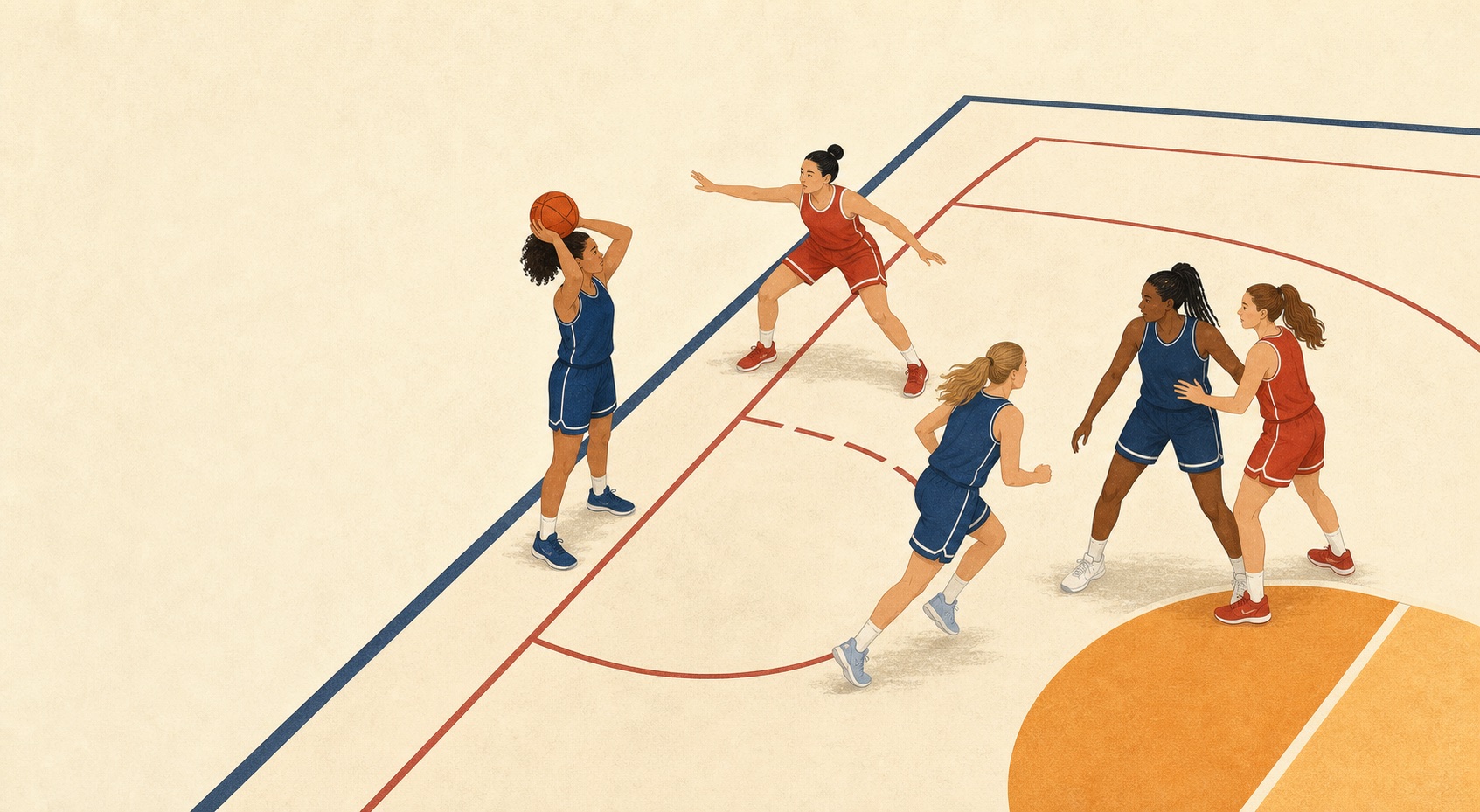
Women players demonstrating a throw-in and an off-ball screen on a half court

00 · TL;DR

Remember these three lines

  1. 1 mAt a designated throw-in spot, lateral movement is limited to 1 metre.
  2. Judge a screen at contact: both feet down, body stationary.
  3. 3To reset three seconds, both feet must leave the restricted area.
01

Rule 17

Throw-in matchup: how may each side move?

First identify the restart, then check five seconds, the boundary and defensive distance.

Why it gets calledThe thrower obeys the five-second and movement limits. The defender may mirror, but may not cross the boundary to interfere.

Thrower-in

  • Release within 5 seconds; do not step onto the court while holding the ball.
  • Designated spot: no more than 1 m laterally in total; moving backwards is allowed.
  • After a made basket: use the whole endline or pass to a teammate out of bounds.

Defender

  • You may move, mirror or jump; no body part may cross the boundary before the ball does.
  • When there is less than 2 m of space behind the thrower, stay at least 1 m away.
  • In the last 2:00 of Q4 or overtime, crossing to interfere—or closing inside 1 m in that tight-space situation after the warning—results in a technical foul.

One-line memoryThrower: five seconds and the line. Defender: the line, plus 1 metre when space is tight.

02

Rule 33.7

A moving screener is not automatically a foul

You may move into position. What matters is the instant contact occurs.

Why it gets calledAt contact: be stationary, keep both feet down, and keep shoulders, hips, legs and elbows inside your cylinder.

  • Screening a stationary opponent from behind: allow at least 1 normal step.
  • Screening a moving opponent: allow 1–2 normal steps, depending on speed.
  • Roll after the defender clears; do not chase and add a second bump with hip or shoulder.

One-line memoryMove to the spot; be still at contact.

03

Rule 26

Three seconds does not start on every paint touch

All three conditions must exist before the offensive three-second count applies.

Why it gets calledLive ball in the frontcourt + team control + game clock running.

  • Once the shot leaves the hand, the previous team-control count no longer applies.
  • A player clearly attempting to leave should be given an allowance.
  • To reset: both feet must touch outside the restricted area. The line is part of the area.

One-line memoryBoth feet out resets the count.

04

Rule 25

Travelling: find the pivot foot first

Do not count feet alone—first identify when the player gains control.

Why it gets calledTo start a dribble, the ball must leave the hand before the pivot foot lifts.

  • After gathering while moving, two steps are allowed to stop, pass or shoot.
  • You may jump to pass or shoot, but neither foot may return before release.
  • Sliding after falling with the ball is legal; rolling or standing up with it is not.

One-line memoryRelease before the pivot lifts; release before landing.

05

Rule 24

Carrying and double dribble

Ball height is not the key—the question is whether the ball came to rest in the hand.

Why it gets calledCarrying the ball from underneath, or dribbling again after the first dribble ended, is a violation.

  • Letting the ball visibly pause in one hand, then continuing: carry.
  • Two hands on the ball, or the ball resting in one hand: the dribble has ended.
  • A new dribble is allowed after a shot, an opponent’s touch, or a pass/fumble touching another player.

One-line memoryOnce the ball rests in the hand, that dribble is over.

06

Rule 33.4 / 33.10

Charge or block: the defender need not be a statue

After establishing a legal guarding position, a defender may still move sideways or backwards.

Why it gets calledThe defender first faces the ball-handler with both feet down; later torso contact is normally a charge.

  • The defender may not move forward into the ball-handler to create contact.
  • Judge contact on the torso, not whether a defender’s foot briefly left the floor.
  • The no-charge semicircle is not a free-hit zone; pushing, holding, elbows and leg contact may still be fouls.

One-line memoryGet there first, slide legally, judge torso contact.

07 · QUICK CALLS

Four more clocks and lines

When an official raises a counting arm, these are the usual reasons.

5s

Closely guarded

Holding the ball with a defender within 1 m: pass, shoot or dribble within 5 seconds.

8s

Reach frontcourt

After gaining backcourt control, get the ball into the frontcourt within 8 seconds.

24

Attempt a shot

Before 24 expires the ball must leave the hand, then enter or touch the ring.

Backcourt

Your team touches last in frontcourt and first in backcourt: violation.

SOURCE CHECK

Rule sources

This is a simplified player guide. Officials judge the full contact, timing and competition context, and local leagues may use different rules.