Restricted area
FIBAThe 4.90 × 5.80 m three-second rectangle.
NBAThe 4-foot (1.22 m) arc under the rim, which FIBA calls the no-charge semicircle.

Court & core vocabulary
Tap the court to see what each part is called
This half court is drawn to official FIBA dimensions. Tap any line, area or spot to see what it is called, what commentators call it, and why it matters under the rules. Equipment specs and basic vocabulary are further down.
Based on the FIBA 2024 official rules · Checked 25 Aug 2026
QUICK REFERENCE
The names first, the detail after. Every row links to that term’s full entry below, and opening one also highlights it on the diagram.
Careful: “restricted area” means different things in FIBA and the NBA →
| Term | Also called | What it is |
|---|---|---|
| Endline | Baseline | The short boundary at each end. |
| Sideline | The two long boundaries. | |
| Centre line | Half-court line | Splits the court into frontcourt and backcourt, and extends 15 cm past each sideline. |
| Three-point line | The arc | A 6.75 m arc drawn from the point below the ring centre, straightening into lines parallel to each sideline in the corners. |
| Free-throw line | The line a free throw is shot from behind, parallel to the endline, 5.80 m from its inner edge and 3.60 m long. | |
| Lane line | Runs from the endline to the free-throw line extended, down each side of the lane. | |
| Restricted area | The paint / The lane / The key | The rectangle formed by the endline, the lane lines and the free-throw line extended. |
| No-charge semicircle | Restricted area (NBA) | A 1.25 m semicircle under the basket. |
| Top of the key | Just outside the top of the arc, straight out from the basket. | |
| Wing | Outside the arc on either side, roughly level with the free-throw line. | |
| Corner | The corner three | The narrow strip outside the arc where the sideline meets the endline. |
Tap anywhere on the court to see its name
You can also pick a term from the list and the diagram will highlight it.
Every line painted on the floor. A lot of calls come down to which side a line belongs to and whether stepping on it counts.
Also calledBaseline
15 m wide
The short boundary at each end. The line itself is out of bounds, so touching it puts you out. After a made basket the throw-in comes from behind it, and the thrower can move anywhere along the endline.
28 m long
The two long boundaries. Like the endline, the line itself is out of bounds. Court dimensions are measured between the inner edges.
Also calledHalf-court line
14 m from each endline
Splits the court into frontcourt and backcourt, and extends 15 cm past each sideline. The centre line counts as backcourt, so a ball-handler touching it is still in the backcourt. That is where most backcourt-violation arguments come from.
Also calledThe arc
6.75 m · 6.60 m in the corners
A 6.75 m arc drawn from the point below the ring centre, straightening into lines parallel to each sideline in the corners. The line counts as two-point territory, so a shooter touching it scores two.
5.80 m out · 3.60 m long
The line a free throw is shot from behind, parallel to the endline, 5.80 m from its inner edge and 3.60 m long. The line painted on the floor runs all the way out to the lane lines, but the rulebook only means that middle 3.60 m.
5.80 m long
Runs from the endline to the free-throw line extended, down each side of the lane. The line is part of the restricted area, so standing on it still counts as inside. To reset three seconds, both feet have to land fully outside.
8.325 m from the endline
A short mark outside each sideline, 8.325 m from the endline. Play restarts from here after an unsportsmanlike or disqualifying foul, and in the last two minutes of the fourth quarter and of each overtime a team that would restart in its own backcourt may switch to it after taking a time-out.
The areas those lines enclose. Most of the counts and calls in the rulebook happen inside them.
Also calledThe paint / The lane / The key
4.90 × 5.80 m
The rectangle formed by the endline, the lane lines and the free-throw line extended. It is usually painted a solid colour, which is where "the paint" comes from. While your team has the ball and the clock is running, an offensive player cannot stay inside for more than three seconds.
Also calledRestricted area (NBA)
1.25 m radius
A 1.25 m semicircle under the basket. It protects a driving player who is already in the air and shooting or passing: contact with a defender who has a foot inside the arc is not a charge. Contact made with both feet on the floor is not covered, and pushing, holding, elbows and leg contact are fouls either way.
1.80 m radius
Centred on the middle of the free-throw line, 1.80 m radius. The half nearer the basket falls inside the lane, so it is dashed. The shooter has to release from inside this circle, behind the line.
Also calledJump circle
1.80 m radius
A 1.80 m circle in the middle of the court, used for the opening jump ball. Held balls after that are not jumped; the alternating possession arrow decides who gets it.
14 × 15 m each
Split at the centre line: the half you attack is your frontcourt, the half you defend is your backcourt. You get eight seconds to move the ball into the frontcourt. Once it is there, touching it last in the frontcourt and first in the backcourt is a violation.
You will not find these in the rulebook, but coaches and commentators use them constantly. They are how plays actually get described.
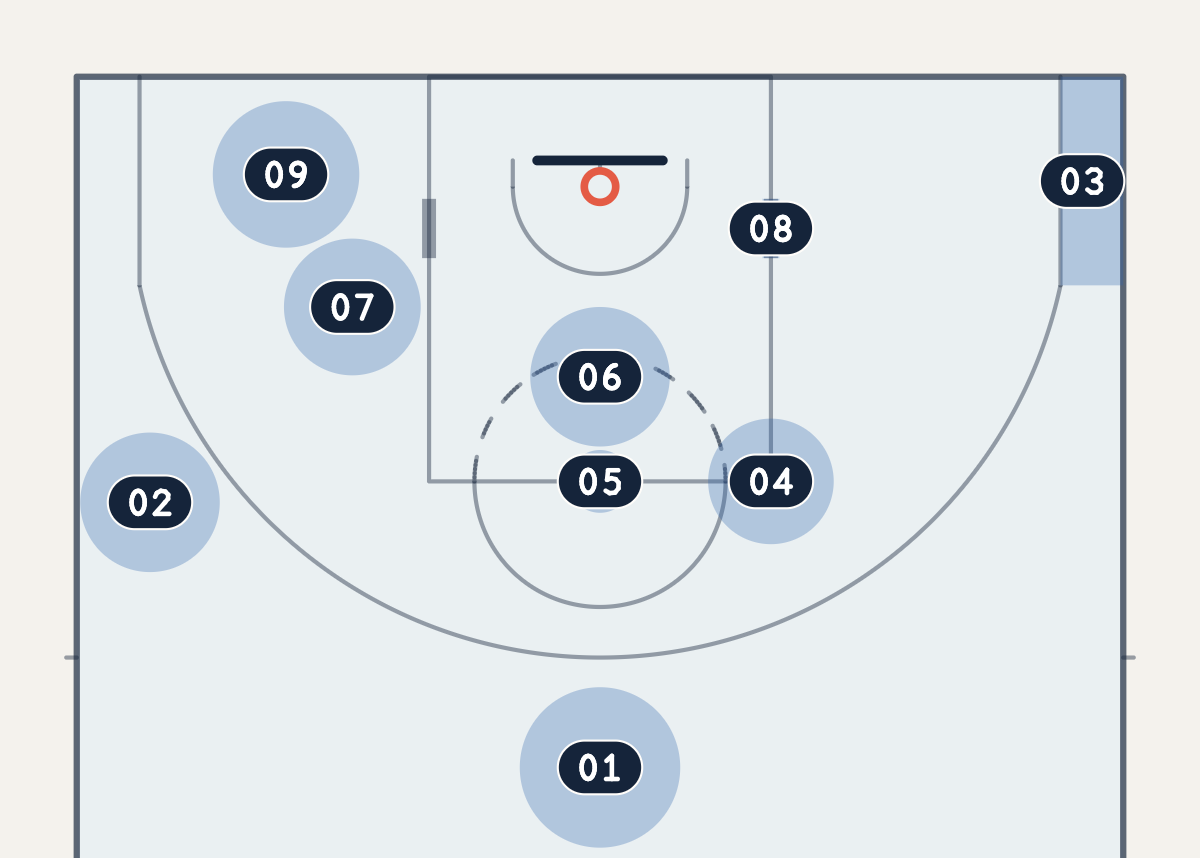
Just outside the top of the arc, straight out from the basket. You can see the whole half court from here, so most pick-and-rolls start there.
Outside the arc on either side, roughly level with the free-throw line. Close enough to shoot and to drive, so it is where most off-ball cuts end up catching the ball.
Also calledThe corner three
0.90 m of standing room
The narrow strip outside the arc where the sideline meets the endline. It is the shortest three on the floor at 6.60 m, but there is only 0.90 m to stand in, so a small drift puts a foot on the line.
The two right angles where the free-throw line meets the lane lines. A standard spot for mid-range jumpers and hand-offs.
The exact middle of the free-throw line. Many floors have a fixed stud there, which is where the name comes from. A defender standing on it can help at the rim and still recover to either side, so it anchors a packed-in defense.
The part of the lane up near the free-throw line. A big who catches there can pass, face up and attack, or set a screen from a standstill.
Beside the lane, close to the basket. The usual place to back a defender down, and the best spot to go up for an offensive rebound.
Also calledFirst lane space
1.75 m from the endline
The solid 0.85 m mark on the lane line, 1.75 m out from the endline. Players line up on these spaces for free throws, and coaches use it to describe how deep a big should post up.
Also calledDunker spot
The two-point area along the endline, between the lane and the corner. Standing there keeps you out of the three-second count and one step away from a finish or a tip-in.
Specifications for the board, ring, ball and clocks. They are what makes a court official.
1.80 × 1.05 m
A 1.80 × 1.05 m transparent panel. Its lower edge is 2.90 m off the floor and its face sits 1.20 m in from the endline. The top of the inner square is level with the ring, which is what you aim at on a bank shot.
Also calledRim / Hoop
45 cm across · 3.05 m high
A solid orange ring 45 cm across, 3.05 m off the floor and 15 cm clear of the backboard. A ball wedged between the ring and the backboard is a held ball and restarts on the possession arrow. A ball merely sitting on the ring is still live, and touching it there is interference.
40 to 45 cm long
The white net under the ring, 40 to 45 cm long. It slows the ball on its way through so officials can see that it really went in.
Also calledStanchion
The whole structure holding up the board and ring, padding included. In official games the base has to sit at least 2 m back from the endline, with padding in a contrasting colour.
Size 7 / Size 6
Size 7 (749 to 780 mm) for men's competition, size 6 (724 to 737 mm) for women's and for boys under 15. To check the pressure, drop it from 1.80 m: it should bounce back to between 1.20 and 1.40 m.
24 s / 14 s
Shows how long the attacking team has left. A fresh possession starts at 24 seconds, and an offensive rebound resets it to 14. On a frontcourt throw-in to the team that already had the ball, anything above 14 drops to 14, while anything below it simply keeps running.
The officials' desk outside the centre line, where the scorer, timer and shot-clock operator sit. Substitutions and timeouts are requested here, and the possession arrow sits on it.
The words that come up in every possession, whether you are playing or watching.
Bouncing the ball with one hand while you move. The dribble ends as soon as the ball comes to rest in your hand or both hands touch it. Starting another one after that is a double dribble.
Getting the ball to a teammate. The common ones are the chest pass, the bounce pass and the overhead pass.
An attempt at the basket. Releasing it in the air is a jump shot. If you are fouled after the shooting motion has started, you get free throws.
Taking the ball to the rim and finishing with one hand, off the glass or straight in. You normally use the outside hand and keep your body between the defender and the ball.
Grabbing the ball after a missed shot. At the basket you are attacking it is an offensive rebound; at the one you are defending, a defensive rebound.
Legally getting a hand on a shot while it is still on the way up. Once the ball is completely above ring level, touching it on its way down is goaltending, and so is touching it any time after it has hit the backboard. Below ring level, swatting it away is still legal.
Taking the ball straight off an opponent's pass or dribble. The other team is charged with a turnover at the same time.
The pass that leads straight to a made basket. Only the last pass counts, and a dribble or two on the way to the rim does not cancel it. But if the scorer catches, hesitates and then creates the shot alone, no assist is credited.
Also calledPick
Using your body to block a defender so a teammate can get free. At the moment of contact you have to be still with both feet down, otherwise it is a moving screen.
An off-ball player changing pace to get to the basket or to open space. Passing and cutting straight away is the classic give and go.
The foot that stays planted once you stop with the ball; the other one is free to step. To start a dribble the ball has to leave your hand before that foot comes up, or it is travelling.
Sealing an opponent behind you once a shot goes up, so you own the space to rebound. It is about position and timing, not shoving with your hands.
Pushing the ball up straight after you get it, before the defense is set. With a numbers advantage it becomes a 3-on-2 or a 2-on-1.
Losing the ball without getting a shot off. Bad passes, steals, travelling and other violations all count.
Illegal contact with an opponent. Under FIBA rules five personal fouls put a player out of the game; the NBA allows six. Once a team has four team fouls in a quarter, every defensive foul after that gives two free throws.
FALSE FRIENDS
These are the terms that stop lining up when you switch between international games and NBA broadcasts. Everything else on this page follows FIBA.
FIBAThe 4.90 × 5.80 m three-second rectangle.
NBAThe 4-foot (1.22 m) arc under the rim, which FIBA calls the no-charge semicircle.
FIBA6.75 m at the top, 6.60 m in the corners.
NBA23 ft 9 in (7.24 m) at the top and 22 ft (6.70 m) in the corners, almost half a metre deeper than FIBA.
FIBAOnly offensive three seconds exists.
NBADefensive three seconds applies too: a defender who stays in the paint without guarding anyone gives up a technical.
FIBA28 × 15 m.
NBA94 × 50 ft, or 28.65 × 15.24 m, slightly bigger all round.
SOURCE CHECK
Every dimension comes from chapter 2 of the FIBA 2024 rules, and the diagram is drawn from those numbers. The slang spot names have no official definition, so we use what coaches and commentators generally say.