The FIBA 2026 Official Basketball Rules take effect on 1 Oct 2026. The biggest change is to how fouls are sorted: the unsportsmanlike foul stops existing and becomes two categories. Here are the 7 changes this guide sets out, old wording beside new.
Based on FIBA’s official change summary · Checked 8 Aug 2026
AT A GLANCE
What this edition changes
1 OctIn force from 1 Oct 2026. Until then games are played under the 2024 edition, and everything on this page describes what is true only from that day.
1 → 2The biggest change is how fouls are sorted: the unsportsmanlike foul stops existing and becomes two categories, disruptive and flagrant, printed as the new abbreviations DI and FL.See “Unsportsmanlike ends” →
7That many changes are set out below: the foul categories, what combination disqualifies, when the act of shooting begins and ends, what officials may review on replay, and socks no longer having to show above the shoe. The list amends a few more articles without changing play; those are noted at the foot of this page.
In one picture
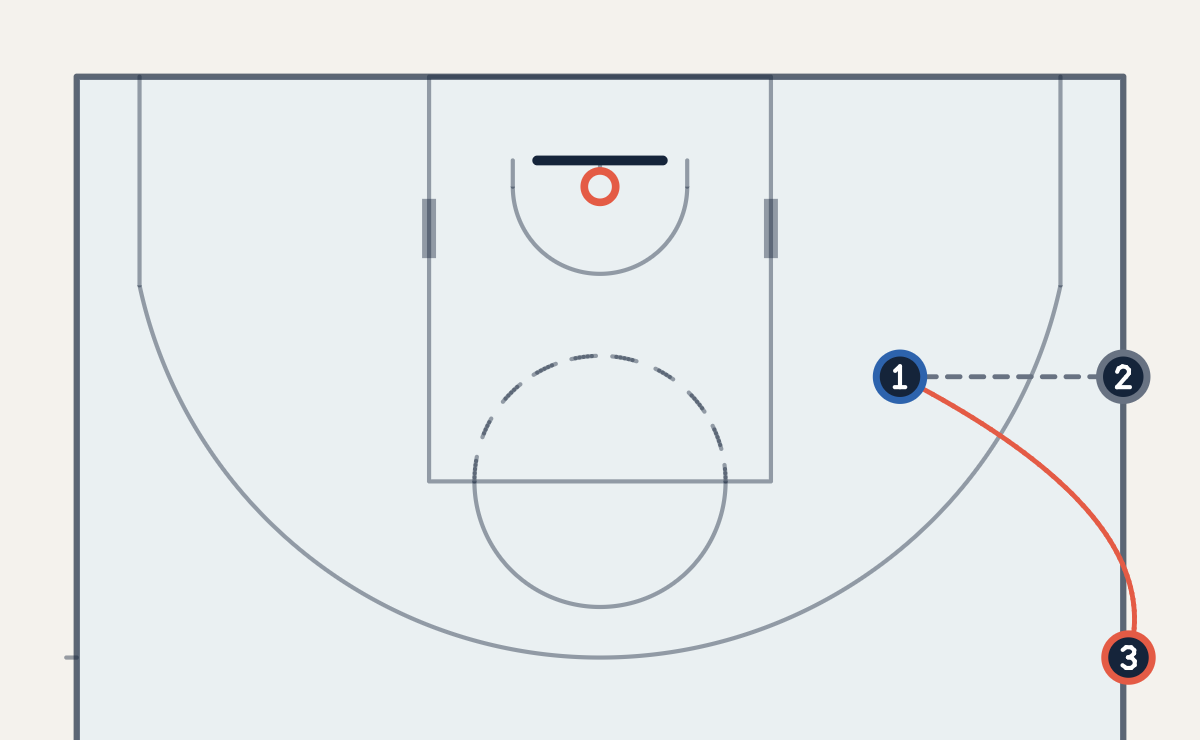
Where the ball comes back in after a disruptive foul
Drawn to FIBA court dimensions: 1 is where the foul happens, 2 and 3 are where the throw-in comes from under each rule.
1Where the foul happens
2An ordinary personal foul: the throw-in comes from the nearest point out of bounds
3A disruptive foul: after the free throws, the throw-in moves to the throw-in line in the frontcourt
01Rule 37 · 38
The unsportsmanlike foul is retired and split in two
The question this answers: Does the unsportsmanlike foul still exist under the FIBA 2026 rules?
FIBA 2024Now, until the changeover
A single unsportsmanlike foul covered both the tactical foul thrown only to stop a fast break and contact that was heavy or made with no attempt to play the ball. Two very different acts, one penalty band.
→
FIBA 2026From 1 Oct 2026
The category is gone. In its place are two: the disruptive foul, for contact that breaks up the flow of the game, and the flagrant foul, for contact whose nature or severity goes beyond what a personal or disruptive foul covers.
Why it changedOne label was carrying two different acts, so no single penalty band could be fair to both.
What it means for youTwo new abbreviations, DI and FL, appear on scoresheets and broadcast graphics. Do not read either as the old unsportsmanlike foul.
02Rule 37
The disruptive foul: free throws and the ball, but it never disqualifies
The question this answers: How is a disruptive foul penalised, and do two of them get a player thrown out?
FIBA 2024Now, until the changeover
A tactical grab was an unsportsmanlike foul, and two of those meant automatic disqualification. Fouling to stop the clock could cost a player the rest of the game.
→
FIBA 2026From 1 Oct 2026
A disruptive foul is illegal contact that stops short of flagrant but breaks up the game and leaves the opponent at a disadvantage. Penalty: 2 free throws when the player was not shooting; the goal plus 1 free throw if it was in the act of shooting and went in, or 2 or 3 free throws if it missed. Then a throw-in at the throw-in line in that team’s frontcourt. Disruptive fouls do not count towards disqualification.
Why it changedStopping a break on purpose should cost something, but not the same as playing dangerously.
What it means for youThe late-game tactical foul gets cheaper in one specific way: it still concedes two shots and the ball, but it no longer carries the two-and-you-are-gone risk.
03Rule 38
The flagrant foul takes over the heavy half
The question this answers: What kind of contact gets called a flagrant foul?
FIBA 2024Now, until the changeover
Excessive or violent contact, and contact made with no legitimate attempt to play the ball, were both handled as unsportsmanlike fouls, escalating to a disqualifying foul only in the worst cases.
→
FIBA 2026From 1 Oct 2026
A flagrant foul is illegal contact that violates the spirit of sportsmanship and fair play and, by its nature or severity, exceeds what a personal or a disruptive foul covers. The heaviest part of the old unsportsmanlike category lands here.
Why it changedSeparating dangerous contact lets the penalty match the severity.
What it means for youThe line worth remembering in rec and amateur leagues: swinging an arm or pulling someone down now has a category of its own.
04Rule 36 · 38 · 39
The count that ends a player’s game is rewritten
The question this answers: Under the FIBA 2026 rules, what combination of fouls disqualifies a player?
FIBA 2024Now, until the changeover
Two unsportsmanlike fouls, two technical fouls, or one of each in the same game meant disqualification.
→
FIBA 2026From 1 Oct 2026
It becomes two Category 1 technical fouls, two flagrant fouls, or one Category 1 technical plus one flagrant. Technical fouls are split into two categories at the same time, and only the accumulating one, Category 1, feeds this count. Disruptive fouls do not feed it at all.
Why it changedOnce tactical contact was split off, the count that ends a game only needed to watch the two categories that warrant it.
What it means for youThe five-personal-foul rule is a separate count and still runs on its own; do not add the two together.
05Rule 15
When the act of shooting starts is now spelled out
The question this answers: When does the act of shooting begin and end, and does manufacturing a shooting foul still work?
FIBA 2024Now, until the changeover
The definition left room to interpret, so a player could draw contact first and add a throwing motion afterwards, turning an ordinary foul into free throws.
→
FIBA 2026From 1 Oct 2026
For jump shots and shots on the move, the act of shooting starts when the player begins to move both the shoulders and the ball upward towards the basket, and ends when the ball has left the hand or hands. It has to be an unmistakable upward attempt at the basket.
Why it changedFIBA states the change addresses players increasingly manufacturing shooting fouls, in transition and in half-court offense alike.
What it means for youTaking the contact first and lifting the ball afterwards no longer converts into two or three free throws. The upward motion has to have started before the contact.
06Rule F.3.2 · F.3.3
Instant replay gets two more things it may look at
The question this answers: What new situations may officials review on replay from 2026?
FIBA 2024Now, until the changeover
The Instant Replay System covered a fixed list of situations, and neither goaltending after a foul nor a foul during a throw-in was on it.
→
FIBA 2026From 1 Oct 2026
Two additions. A goaltending or basket-interference call after a foul may be reviewed at any point in the game. And in the last 2:00 of the fourth quarter and of each overtime, officials may review whether the ball was still in the thrower-in’s hands when the defense fouled, which is what decides whether the throw-in foul penalty applies.
Why it changedBoth decide points or possession outright, and both happen at the moments hardest to judge in real time.
What it means for youOnly applies where an Instant Replay System is installed. Grassroots games without one are unaffected.
07Rule 4
Socks no longer have to show above the shoe
The question this answers: What changes for socks and uniforms under the FIBA 2026 rules?
FIBA 2024Now, until the changeover
Socks had to be visible above the shoe. It was a mandatory kit requirement.
→
FIBA 2026From 1 Oct 2026
The requirement that socks be visible is dropped, one of a set of appearance rules FIBA relaxed together.
Why it changedIt is an appearance rule with no bearing on fairness.
What it means for youThe lightest change here for a player, and the one most likely to have held someone up in a pre-game kit check.
NOT IN THE CHANGE LIST
FIBA’s change summary does not touch these
The tiring part of a new edition is telling what moved from what did not. None of the following appears in FIBA’s published change summary, so the main guide still describes them correctly.
Court dimensions and the three-point distance
The 24-, 8- and 5-second counts, and offensive three seconds
How travelling and backcourt violations are judged
Four 10-minute quarters, 5-minute overtimes and the timeout allowance
Five personal fouls and out, and 2 free throws from a team’s fifth foul in a quarter
A few more articles are on the list without changing how the game is played: court markings get more freedom in colour as long as they contrast sharply with the floor (Art. 2), Art. 24.2 was reworded so double-dribble reads more consistently, and Art. 1 gained a definition. This page does not detail them; read the official text.
COMMON QUESTIONS
What people ask about the 2026 rules
Each change above answers a question of its own, on its own card. These three run across the whole edition.
When do the FIBA 2026 rules take effect?
The FIBA 2026 Official Basketball Rules take effect on 1 Oct 2026. Games before that date are played under the 2024 edition, with no transition period between them. National leagues may adopt the new edition on their own timetable, so what your competition has adopted is what governs your game.
What changes in the FIBA 2026 rules?
This page sets out 7 changes. The most consequential is the foul categories: the unsportsmanlike foul is retired and split into a disruptive foul and a flagrant foul, and what combination disqualifies a player changes with it. The rest redefine when the act of shooting begins and ends, widen what officials may review on replay, and drop the requirement that socks show above the shoe. FIBA’s list amends a few more articles without changing how the game is played. Court dimensions, the second counts and how travelling is judged are not on it at all.
What is a disruptive foul?
A disruptive foul (DI) is one of the two categories that replace the unsportsmanlike foul from 1 Oct 2026. It covers illegal contact that stops short of flagrant but breaks up the flow of the game and leaves the opponent at a disadvantage: the tactical grab thrown to stop the clock or a fast break. The penalty is two free throws when the player was not shooting, or the goal plus one free throw if the foul came in the act of shooting and the shot went in, or two or three free throws if it missed. Play then restarts with a throw-in at the throw-in line in the fouled team’s frontcourt. Disruptive fouls do not count towards disqualification, which is the practical difference from the unsportsmanlike foul they replace.
OFFICIAL SOURCES
Every line here is checkable
This page summarises FIBA’s own published list of changes; it is not a translation of the rulebook. The official text, and whatever your league adopts, is what actually governs a game.