Checked September 5, 2026 · FIBA 2024 rules / WNBA 2026 rules
The quick answer
What’s different, and what stays the same?
The ball isn’t a men’s ball. The main three-point arc is essentially the same distance. The bigger adjustments happen in the paint and on the whistle.
What you’re comparing
FIBA
WNBA
Main three-point arc
6.75 m
22 ft 1¾ in (about 6.75 m)
The corner three
6.60 m
22 ft (about 6.71 m)
Women’s basketball
Size 6, Molten
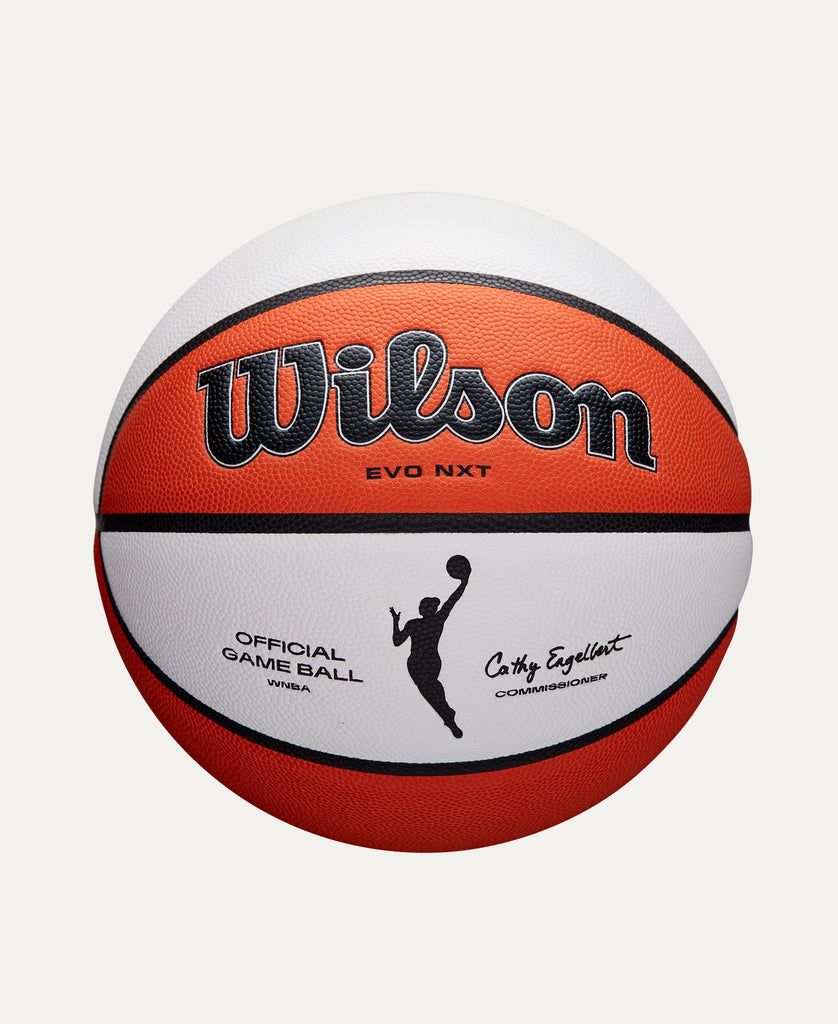
Size 6, Wilson
Game length
Four 10-minute quarters
Four quarters of 10 minutes
Defensive three seconds
No defensive three-second violation
Defensive three-second rule applies
Foul-out limit
5 player fouls
6 personal fouls
Three-point line
Is the FIBA three-point line closer?
At the top of the arc, almost nothing changes. In the corner, the FIBA line is about 11 cm closer. Switch the markings below to see where the difference actually is.
FIBA · solid redWNBA · dashed blue
Look closer at the corner
The outlined corner above is enlarged here. This is where the straight three-point lines separate. Both views use the same rulebook measurements.
About 11 cm closer in FIBA
FIBA 6.60 mWNBA 22 ft (about 6.71 m)
Main arc: about 6.75 m in bothCorner: 6.60 m vs 6.71 m
Same scale, aligned at the basket. Solid: FIBA. Dashed: WNBA. This diagram isolates the boundary and three-point line.
The full court is slightly smaller too: 28 × 15 m in FIBA, versus 94 × 50 ft (28.65 × 15.24 m) in the WNBA.Explore court dimensions →
Game ball
Is the FIBA ball bigger?
Both use a size-6 ball. The World Cup ball is a Molten BG5000; the WNBA uses Wilson. Different graphics and surface construction do not make one a different size category.
Molten BG5000
2026 Women’s World Cup official game ball · Size 6
Product photo: manufacturer. Images are not a measurement comparison.
Then why does it look different?
Molten’s BG5000 has 12 panels: eight orange and four ivory. That gives it a different pattern from the Wilson ball. We haven’t found evidence that the panel pattern makes it look larger, so we wouldn’t present that explanation as a fact.
The calls
Two calls that can catch you out
Why can the defender stay in the paint?
FIBA
No defensive three-second restriction.
WNBA
The defensive three-second rule applies.
In the WNBA, a defender cannot stay in the lane indefinitely without actively guarding an opponent. Offensive three seconds still applies in both.
Try this next possession
Watch the defender nearest the rim. If they stay deep, notice whether the offense uses a screen, a cut or a pass to pull them away.
Can they touch the ball after it hits the rim?
FIBA
In live play, a ball that has hit the rim can be played above it.
WNBA
After rim contact, the imaginary cylinder above the ring remains protected.
FIBA still prohibits interference, such as reaching through the basket from below or shaking the rim to change the bounce. A whistle or end-of-period signal can also stop players touching a ball that could still go in.
Try this next possession
On the next miss, watch when the rebounder reaches for the ball: before it touches the rim, after it touches, or after it moves clear.
One fewer foul to give: a FIBA player leaves after five player fouls; a WNBA player normally fouls out at six personal fouls. Keep an eye on the foul count when a coach makes an early substitution.
What to watch next
Take one thing into the next game
You don’t need to follow all ten players. Pick one question, watch a few possessions, then use an animation to check what you saw.
01
Who follows the screener?
Watch the screener’s defender. Do they step out toward the ball, stay back, or exchange players with a teammate?