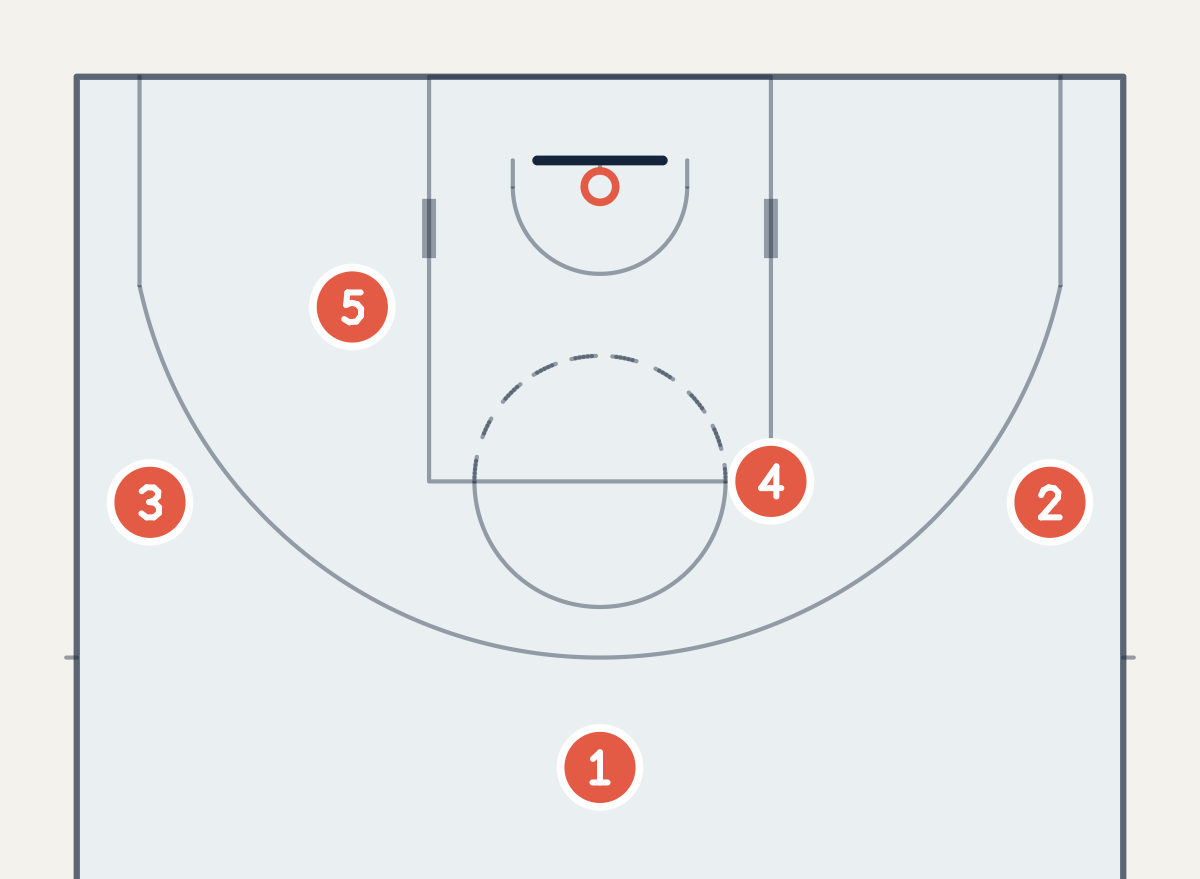
A number describes the job in a possession, not how tall you are. All 5 of them are here with the duties, the spots they live in, what the role asks of you, and the one thing people most often get wrong about it. Where to move without the ball is on the cheat sheet.
Updated 8 Aug 2026
1PG
控球后卫Point guard
Also calledThe one, the lead guard
Get the ball across half court, decide what the possession is going to be, and make sure a teammate gets a good look before the clock runs out.
What the job is
Beat pressure into the frontcourt inside eight seconds, and give the ball up to an outlet rather than dribbling into trouble.
Read how the defense is set, then call for a ball screen, feed the post, or reset and space.
Control tempo: slow it down ahead, push it behind, and know whose shot the last possession belongs to.
Get back first once your team shoots, so nobody runs out on you.
What it asks of youBoth hands have to work, and keeping your head up matters far more than handling anything fancy. Height is not the barrier. Vision and staying calm are.
The usual mythThat the point guard is whoever scores most and holds the ball longest. The role is measured by the quality of everyone else’s shots, not the volume of your own.
2SG
得分后卫Shooting guard
Also calledThe two, the off guard
Get open without the ball, and be ready to decide the moment it arrives: shoot, drive, or move it on.
What the job is
Come off down screens and staggers with your shoulders already square to the rim.
Catch and shoot: have the feet set before the ball lands, not after.
Decide inside half a second of catching it. Shoot, drive or pass, but do not stand and think.
Usually guard their best shooter, which means chasing over screens instead of ducking under them.
What it asks of youLegs that keep running, a shot that repeats, and the willingness to keep moving through the large majority of the game when the ball is somewhere else.
The usual mythThat the job is shooting and nothing else. This position usually covers more ground than anyone on the floor, and most of its shots are run into rather than asked for.
3SF
小前锋Small forward
Also calledThe three, the wing
The most complete job on the floor: shoot, drive, and guard two or three positions, filling whatever the lineup is short of.
What the job is
Cut the instant your defender turns to look at the ball.
Face up and read the cushion: close means drive, deep means shoot.
In transition, run the sidelines to stretch the floor long.
After a switch, hold up against a big for a possession or two and still stay in front of a guard.
What it asks of youYou need to hold contact and still slide your feet. The position rewards being able to do a bit of everything, as long as none of it is a hole.
The usual mythThat it is where you end up if you have no standout skill. It is usually the hardest position on a team to replace, because it asks for offensive decisions and defensive range at the same time.
4PF
大前锋Power forward
Also calledThe four, the power forward
Do the work inside while pulling their big away from the rim: set screens, rebound, and step out to shoot.
What the job is
Set real ball screens and be stationary at contact.
Roll or pop after the screen, depending on whether they switched or hedged.
Crash the offensive glass on every shot, which is the steadiest source of points the position has.
Be the first help when the rim is attacked, then recover to box out your own.
What it asks of youLower-body strength and the habit of boxing out. Add a mid-range or a three and the spacing of the whole offense changes.
The usual mythThat you have to be tall and heavy. Modern lineups more often want a four who shoots threes and can switch onto a guard, with height well down the list.
5C
中锋Center
Also calledThe five, the big
Protect the rim, take the rebounds, and turn other people’s drives into points. You will set far more screens than you take shots.
What the job is
Guard the rim by holding position rather than jumping, and make the finisher change the shot.
Box out first and look for the ball second. Reversing the order is why boards get lost.
Roll hard to the rim after the screen, catching as close to it as you can.
Play as the hub from the high post, handing off to cutters or hitting the baseline.
What it asks of youPositioning beats leaping and boxing out beats blocking. Soft hands matter, because passes will arrive from every angle.
The usual mythThat the center is just the tallest person standing under the rim. What decides the position is judgment about position and rim protection, and plenty of people play it well without the height.
NOT AN IDENTITY
A position is a word for talking, not a label you wear
The numbers started out describing where people stood and now mostly describe what they do. A team can play two guards who both organize, or park its center outside the arc. Calling a number is a way for five people to agree on spacing in two seconds, not an assignment for life. Which is why the hybrid labels below exist at all.
Combo guardPlays the one and the two, organizing on some possessions and scoring on others.
Point forwardA forward-sized player who starts the offense, which teams use when the matchup is smaller.
Stretch fourA four who stands behind the arc and drags their big away from the rim.
Positionless lineupFive similar-sized players who can all switch, so nobody has a fixed matchup.
READ NEXT
Once you know your number
A number tells you what you are responsible for, not where to stand second by second. The rest of it is off-ball movement, and understanding the spot names your teammates shout.