控衛傳向側翼後,借肘區隊友的背掩護直切籃筐。 · The guard passes to the wing and cuts to the rim off an elbow back screen.
也叫UCLA 掩護 · 肘區背掩護 · UCLA screen · UCLA action · elbow back screen · high post back screen
難度 · Difficulty
3/5
適用人數 · Formats
3v3 · 4v4 · 5v5
連續分步動畫 · Continuous step animation
先看整體,再逐步拆解 · See the whole action, then inspect each step
1234××××
1/4肘區與側翼建立站位 · Set the elbow and wing
靜態戰術圖 · Static play diagram
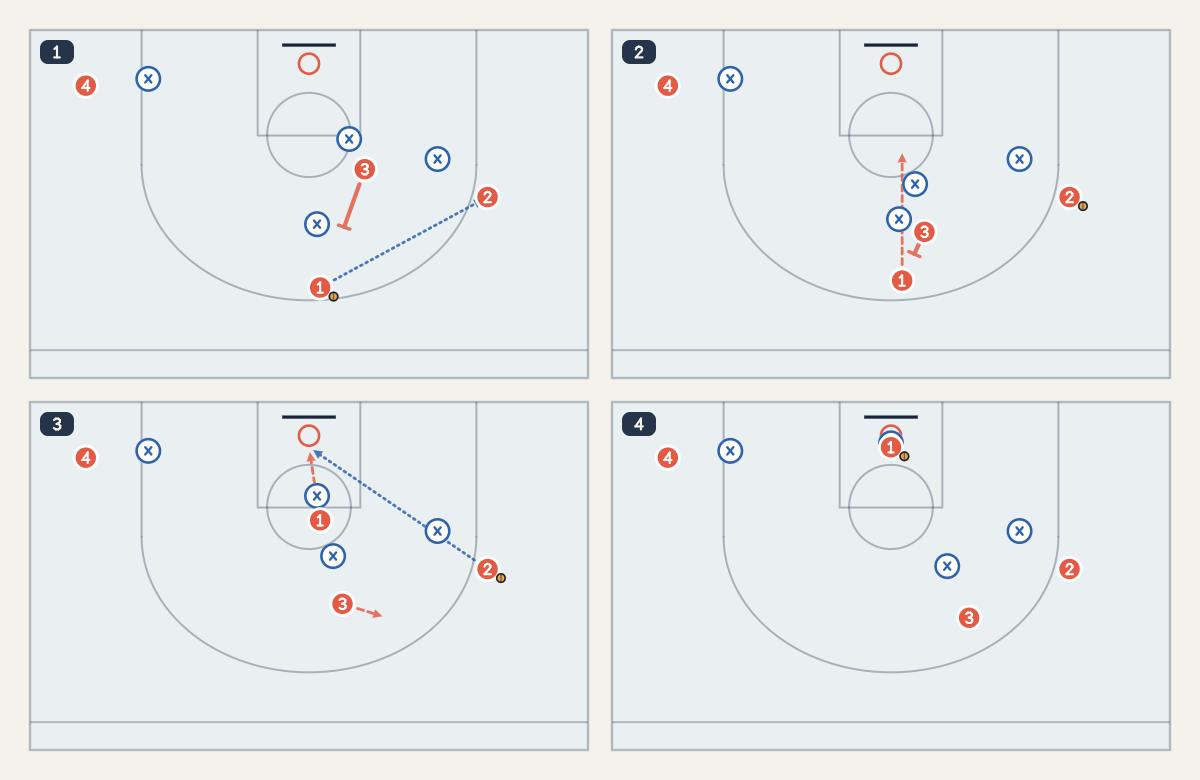
UCLA 切入戰術圖:四步跑位一圖看完 · UCLA Cut diagram: all four steps on one board
按 4v4 站位繪製,與上方動畫的默認人數一致。長按或右鍵即可保存,帶到球場上講。 · Drawn at 4v4, the same format the animation above opens on. Save it and bring it to the court.
1進攻球員,按 1 到 4 號編號 · Offense, numbered 1 to 4
×防守球員 · Defenders
跑動或運球路線 · Cut or drive
傳球路線 · Pass
掩護,短橫是掩護面 · Screen, the bar is the screener’s face
跑法總覽 · Action overview
先看UCLA 切入如何完整運轉 · See how the UCLA Cut flows end to end
控衛傳球到側翼後,借肘區隊友的背掩護從高位直切籃筐;切入必須貼著掩護走直線,側翼把球提前傳到切入者身前,掩護人隨後外彈保持空間。 · After passing to the wing, the guard cuts off a back screen at the elbow straight to the rim. The cut stays tight to the screen, the wing leads the cutter with the pass, and the screener then pops out to maintain spacing.
UCLA 切入要解決什麼問題? · What problem does the UCLA Cut solve?
讓防守沒法既看住球又跟住切入的人,趁這一下直接攻籃。 · Force the defender to choose between seeing the ball and tracking the cutter.
四步跑法 · Four-step walkthrough
怎麼跑UCLA 切入? · How do you run the UCLA Cut?
1
肘區與側翼建立站位 · Set the elbow and wing
2
控衛傳球到側翼 · Guard passes to the wing
3
肘區隊員做背掩護 · Elbow sets a back screen
4
控衛貼掩護切向籃筐 · Guard cuts tightly to the rim
教練口令 · Coaching cues
跑UCLA 切入時隊友只需要記住什麼? · What should players remember in the UCLA Cut?
傳球後第一步衝籃筐 · First step attacks the rim after the pass
背掩護要讓切入人看見 · Keep the back screen visible to the cutter
側翼傳球領先 · Wing leads the cutter with the pass
執行細節 · Execution details
UCLA 切入最容易跑錯在哪裡? · Where does the UCLA Cut usually break down?
傳球後沒有立即借肘區背掩護切入 · Pausing after the wing pass instead of cutting
背掩護離防守太近,沒有保留合法一步距離 · Setting the back screen without legal space
防守閱讀與應對: · Defensive read and counter: 切入被堵住時,掩護人外彈接球並繼續反轉球。 · If the cut is covered, the screener pops out to receive and continue the reversal.
訓練方法 · Practice method
訓練中怎麼練熟UCLA 切入? · How should a team practice the UCLA Cut?
3v3 側翼傳球 + 肘區背掩護;先 0 防守走位,再加入追防。 · 3v3 wing entry and elbow back screen, progressing from walkthrough to live chase.
人數變形 · Format variations
UCLA 切入在 3v3、4v4、5v5 怎麼調整? · How does the UCLA Cut change in 3v3, 4v4 and 5v5?
3v3
肘區背掩護 · Elbow back screen
4v4
UCLA + 弱側拉開 · UCLA + weak-side spacing
5v5
1-4 High UCLA · 1-4 High UCLA
4v4 備戰變化 · 4v4 variations for game prep
UCLA + 側翼擋拆接續UCLA into wing PnR
切入未得球時,肘區隊員順勢給側翼做擋拆繼續進攻。 · If the cut isn't hit, the elbow player flows into a wing ball screen.
假 UCLA 外彈Fake UCLA pop
控衛假裝切入兩步後折返弧頂,接回傳投三分。 · The guard sells the cut for two steps, then bounces back to the top for a return-pass three.
UCLA + 弱側下掩護UCLA with a weak-side pin-down
切入的同時,弱側兩人跑一次下掩護。4v4 只有四名防守者,籃下的切入和外線的接球投籃照顧不過來。 · Run a weak-side pin-down at the same time as the cut. With only four defenders, the basket cut and the catch-and-shoot cannot both be covered.
換防後打高位錯位Post the switch at the elbow
防守換掉背掩護後,肘區隊員在高位面對更小的防守人,其餘三人拉開一側,把這個錯位打完。 · When the defense switches the back screen, the elbow player has a smaller defender at the high post, so the other three clear a side and let the mismatch work.
名字的來源 · Where the name comes from
UCLA 切入為什麼叫 UCLA? · Why is the UCLA cut called the UCLA cut?
這個動作以約翰·伍登(John Wooden)執教的 UCLA 球隊命名。伍登 1948 至 1975 年執掌 UCLA,在 1964 到 1975 的十二個賽季裡拿下十座 NCAA 冠軍。那些球隊跑的進攻體系通常被稱作 UCLA 高位策應進攻(UCLA high post offense),而這套體系的第一個動作,就是控衛把球傳給側翼,隨即借站在肘區隊友的背掩護直切籃筐。其他球隊把這一下學走之後需要給它起個名字,用的就是學校的名字。 · The action is named after the UCLA teams John Wooden coached. Wooden ran the program from 1948 to 1975 and won ten NCAA championships in the twelve seasons between 1964 and 1975. The offense those teams played is usually called the UCLA high post offense, and its opening action was exactly this: the guard entered the ball to the wing and immediately cut to the rim off a back screen from the player standing at the elbow. Opponents who copied the action needed a name for it, and they used the school's.
讓它成為標誌性動作的並不是這一次切入本身,而是伍登從來沒有把它當成一次性戰術。切入只是一連串閱讀裡的第一個:切開了就直接上籃,切不開進攻就自然流向下一個選擇,球轉移到另一側繼續跑。今天沿用這個動作的球隊都保留了這個性質。幾乎沒有人跑 UCLA 切入是奔著那記上籃去的,跑它是因為防守必須尊重那記上籃。 · What made it a signature was not the cut itself but the fact that Wooden never treated it as a set play. The cut was the first read in a sequence: if the guard came open the layup was there, and if not, the offense simply flowed into the next option and the ball reversed to the other side. Teams that lift the action today keep that property. Almost nobody runs a UCLA cut expecting the layup. They run it because the defense is obliged to respect the layup.
六十年過去,它是極少數穿越了每一個籃球時代的動作。在 NBA 的戰術板上,它是一個有名字的啟動方式:喊出 “UCLA” 通常就是指控衛傳側翼、借肘區掩護切入,之後接哪一套再另說。在青少年訓練裡,它往往是無球掩護的第一課。兩邊的理由其實是同一個:它只有一個動作、四秒鐘跑完,而且它逼著球員養成傳球之後立刻切的習慣,而大多數回合恰恰丟在沒有這個習慣上。 · Sixty years on, it is one of the few actions that survived every era of the game. It sits in NBA playbooks as a named entry, where calling "UCLA" usually means the guard passes to the wing and cuts off the elbow before the possession continues into something else. It sits in youth programs as a first lesson in screening away from the ball. The reason is the same in both places: it is one action, it takes four seconds, and it forces a player to cut hard after passing, which is the habit most possessions are lost to.
起始陣型 · Starting alignment
1-4 High 陣型對 UCLA 切入做了什麼? · What does the 1-4 high alignment do for the UCLA cut?
本頁的 5v5 變形寫的是 1-4 High UCLA,這個陣型承擔的工作比名字看上去多。四名球員站在罰球線延長線上:兩人在肘區,兩人在稍高於突破點的側翼;第五人在弧頂持球。罰球線以下一個人也沒有,這正是全部要點,因為回合一開始禁區就是空的。 · The 5v5 variant on this page is labeled 1-4 High UCLA, and the alignment does more work than the name suggests. Four players stand level with the free-throw line extended: two at the elbows, two on the wings just above the break. The fifth has the ball at the top of the key. Nobody is below the free-throw line, which is the entire point, because the possession starts with an empty paint.
禁區空著,切入才可能無人干擾地到達。在常規的雙衛站位加低位內線的陣型裡,控衛切向籃筐會一頭撞進負責盯防那名內線的防守者身上,那個人本來就站在禁區裡承擔補防。而從 1-4 High 出發,那裡根本沒有人站著。任何想保護籃筐的防守者,都得先放掉一個站在肘區或側翼的射手,而且要在切入者已經啟動之後才開始跑那段距離。 · That emptiness is what lets the cut arrive uncontested. In a conventional two-guard front with a post player on the block, a guard cutting to the rim runs straight into the defender assigned to that post player, who is already standing in the lane with help responsibility. Out of 1-4 high there is no help standing there. Any defender who wants to protect the rim has to leave a shooter at the elbow or the wing to do it, and has to cover that ground after the cutter is already moving.
陣型同時決定了掩護的角度。肘區隊員位於切入者的上方、略偏內側,因此背掩護正好設在控衛防守人的上側肩,也就是盲區一側,因為那名防守者剛剛轉頭去跟傳向側翼的球。掩護人只要站得再低一點,切入者就得繞過掩護而不是貼著掩護走,這一步之差通常就是上籃和被封蓋的差別。 · The alignment also sets the angle of the screen. The elbow player starts above the cutter and slightly inside, so the back screen lands on the top shoulder of the defender guarding the ball handler, on the blind side, since that defender has just turned to follow the pass to the wing. A screener standing any lower forces the cutter to run around the screen instead of off it, and that single step is usually the difference between a layup and a contest.
鏡像的 1-4 Low 把同樣四個人擺在底線一帶,產生的是另一組動作:Flex 掩護、橫掩護,而且跑不出 UCLA 切入,因為球的上方沒有人可以做掩護。 · The mirror image, 1-4 low, puts the same four players along the baseline. It produces a different family of actions, flex screens and cross screens, and no UCLA cut at all, because there is nobody above the ball to screen with.
對位與防守閱讀 · Coverage reads
UCLA 切入為什麼對區域聯防也有效? · Why does the UCLA cut work against a zone?
盯人防守丟掉切入者,是因為防守者轉頭去看球。區域聯防則從一開始就沒有跟著人:守的是區域、面向的是球,於是當切入發生時,區域頂端的兩名防守者正看著側翼,而切入正好發生在這兩人身後。 · Man-to-man defenders lose the cutter because they turn to watch the pass. Zone defenders never had the cutter to begin with: they are guarding an area and facing the ball, so while the cut is happening the top of the zone is looking at the wing and the cutter is behind it.
面對 2-3 聯防,切入正好穿過頂端兩名防守者之間的縫隙,在底線三人向球側移動的過程中抵達罰球線一帶。面對 1-3-1 更直接,因為頂端那名防守者已經壓向球側,切入走的就是剛剛讓出來的那條通道。 · Against a 2-3, the cut runs down the seam between the two top defenders and arrives around the free-throw line while the back line is still shifting toward the ball. Against a 1-3-1 it is more direct still, because the point defender has already committed to the ball side and the cut travels through the space they vacated.
但有一點必須說清楚:面對區域聯防時,背掩護的作用遠小於切入本身。區域防守不追人,所以常常根本沒有人可掩護,掩護人真正的任務是用身體佔住區域頂端,並隨時準備在中路空出來時接球。把這個動作教成“先做掩護,再切入”的教練,會發現它打區域時經常卡住;教成“球在側翼的同時切進縫隙”的教練,則不會遇到這個問題。 · One thing has to be said plainly. Against a zone the back screen matters far less than the cut. Zone defenders do not chase, so there is often nobody to screen, and the screener's real job is to occupy the top of the zone and to be ready to catch if the middle opens. Coaches who teach the action as "set the screen, then cut" find it stalls against zone. Coaches who teach it as "cut into the gap while the ball is on the wing" do not.
同樣的道理也解釋了它為什麼禁得起換防。如果兩名防守者換掉背掩護,控衛換來的是一個更高更慢的對位,而肘區隊員在高位面對的是一個更小的防守人。這個回合並沒有跑壞,因為錯位本身就是應對,接著把錯位打完即可。 · The same logic explains why it holds up against a switch. If the two defenders switch the back screen, the guard has traded one matchup for a taller, slower one, and the elbow player is now guarded at the high post by someone smaller. Nothing about the possession is broken, because the mismatch is the counter and the offense simply plays it.
術語辨析 · Terms compared
UCLA 切入、UCLA 掩護和其他切入有什麼區別? · What is the difference between a UCLA cut and a UCLA screen?
這幾個名字經常被混用,但在戰術板上它們指的不是同一件事。 · These names get used interchangeably, but on a whiteboard they do not mean the same thing.
UCLA 掩護 · UCLA screen
同一個動作的兩半。UCLA 切入指控衛做的事:傳球給側翼,然後切向籃筐。UCLA 掩護指肘區隊員做的事:那道讓切入變得免費的背掩護。解說把兩者混著用,在標準版本裡沒什麼問題。教練會把它們分開,是當重點在掩護而不在切入的時候,例如用同樣這道肘區背掩護去解放一名下順的內線,這時切的人根本不是控衛。 · Two halves of one action. The UCLA cut is what the guard does: pass to the wing, cut to the rim. The UCLA screen is what the elbow player does: the back screen that makes the cut free. Commentary uses the two interchangeably, and for the standard version that is harmless. Coaches separate them when the screen rather than the cut is the point. The same elbow back screen can be used to free a post player diving to the rim, in which case the guard is not the one cutting at all.
反跑 · Backdoor cut
反跑沒有掩護,它是一次閱讀:防守人貼出來搶傳球路線,切入者立刻從背後溜到籃下。UCLA 切入則是排定好的,無論防守貼不貼,傳完球都要切,而且切的時候有一道掩護在等著。反跑靠的是防守先犯錯,UCLA 切入不需要。 · A backdoor has no screen. It is a read: the defender overplays the passing lane, and the cutter goes behind that defender to the rim. The UCLA cut is scheduled instead. The guard cuts after the entry pass whether or not the defense is overplaying, and there is a screen waiting when the cut starts. A backdoor needs the defense to make a mistake first; the UCLA cut does not.
傳切 · Give and go
傳切是同一個“傳完就切”的想法,但沒有掩護,而且切入者奔著立刻要回球去。UCLA 切入加了一道背掩護,並且默認球不會回來,因為它是一次啟動而不是一次終結。這個差別很實際:傳切切不開就等於這次配合失敗,而 UCLA 切不開只是把進攻推進到下一個選擇。 · A give and go is the same pass-and-cut idea without a screen, and the cutter fully expects the ball back immediately. The UCLA cut adds a back screen and assumes the ball is not coming, because it is an entry rather than a finish. That difference is practical: a give and go that is covered has failed, while a UCLA cut that is covered has simply moved the offense to its next option.
Iverson 切入 · Iverson cut
兩者都從弧頂出發,方向和目的卻相反。Iverson 切入橫穿兩個肘區,發生在傳球之前,通常是為了讓得分手在側翼接到球;UCLA 切入從上往下走向籃筐,發生在傳球之後,目的是直接攻擊籃筐。一個是為了接球,一個是為了得分。 · Both start at the top of the key, and they run in opposite directions for opposite reasons. An Iverson cut travels sideways across the two elbows and happens before the entry pass, usually to get a scorer the ball on the wing. The UCLA cut travels down toward the rim and happens after the entry pass, to attack the basket directly. One is a way to receive the ball, the other a way to score.
後續手段 · Continuations
UCLA 切入沒切開之後怎麼辦? · What do you run when the UCLA cut is covered?
切不開是常態而不是意外。下面五種接續都從同一個站位繼續,不需要重新落位。 · A covered cut is the normal outcome, not a failure. All five continuations below carry on from the same alignment, with no reset.
掩護人外彈 · The screener pops out
最基礎的一條:切入者穿過籃下繼續走,肘區的掩護人立刻外彈回弧頂接球,把球轉移到弱側。這一下讓進攻保持流動,也把剛剛被掩護擠開的防守者留在錯誤的一側。 · The basic one. The cutter clears through the lane and the elbow screener pops straight back out to the top to receive and reverse the ball. It keeps the offense moving and leaves the defender who was just screened trailing on the wrong side of the floor.
掩護人下順 · The screener slips
如果防守準備換防,掩護人就不做掩護,在接觸之前直接轉身下順籃下。換防的兩個人會同時撲向控衛,籃下反而空出來。判斷依據很簡單:看到對方兩名防守者提前靠攏,就下順。 · If the defense is preparing to switch, the screener never sets the screen and instead turns and slips to the rim before contact. Both defenders commit to the guard and the basket area opens instead. The read is simple: when the two defenders start closing on each other early, slip it.
切入者要位 · The cutter seals
如果防守人從掩護上方追過來,切入者不必空跑到底角,可以在低位直接封住對位要球。側翼傳球的角度是現成的,這是全場最便宜的一次低位單打機會。 · If the defender trails over the top of the screen, the cutter does not have to keep running to the corner and can seal on the block and ask for the ball. The wing already has the passing angle, which makes it the cheapest post-up the offense will get all night.
接底角下掩護 · Into a corner pin-down
切入者穿過籃下到底角,肘區隊員緊接著跟下去做一次下掩護,讓切入者從底角繞出來接球投籃。防守剛剛經歷一次背掩護,第二次連續掩護最容易被打亂。 · The cutter continues through to the corner, and the elbow player follows to set a pin-down for a catch-and-shoot coming back out. The defense has just fought through a back screen, and a second screen arriving right behind it is where coverage tends to break.
反向再跑一次 · Reverse and repeat
球轉移到另一側後,同樣的動作可以在對稱位置立刻再跑一次。這正是伍登體系的原始用法:它不是一次戰術呼叫,而是一套可以持續循環的進攻,跑到防守某一次跟丟為止。 · Once the ball has been reversed, the same action runs again on the symmetrical side. This is how the Wooden version was meant to be used in the first place: not as a single call but as a continuity that repeats until one defender is late.