WolfUp Basketball Playbook
Multi-format basketball tactics wiki

TACTIC 09 · 3v3 / 4v4 / 5v5

UCLA CutUCLA 切入

控卫传向侧翼后,借肘区队友的背掩护直切篮筐。The guard passes to the wing and cuts to the rim off an elbow back screen.

难度Difficulty
3/5
适用人数Formats
3v3 · 4v4 · 5v5

连续分步动画Continuous step animation

先看整体,再逐步拆解See the whole action, then inspect each step

1/4 肘区与侧翼建立站位Set the elbow and wing

静态战术图Static play diagram

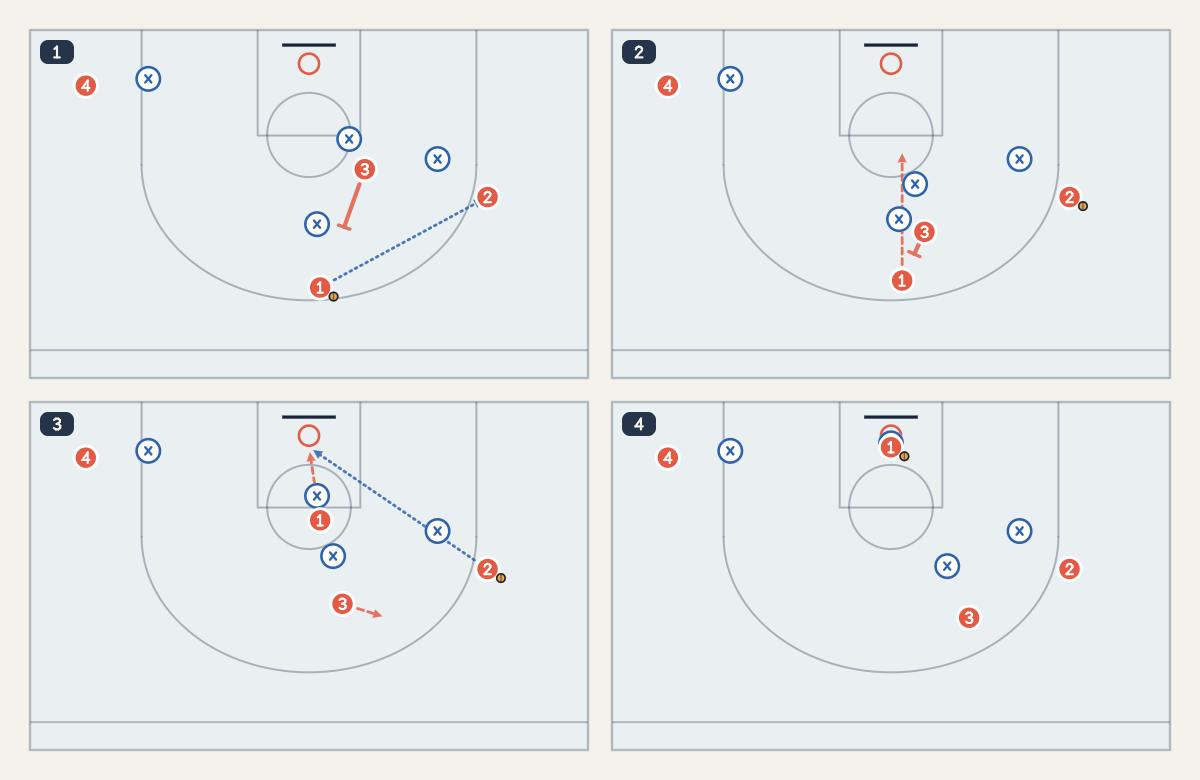
UCLA 切入战术图:四步跑位一图看完UCLA Cut diagram: all four steps on one board

UCLA Cut basketball play diagram: four steps of the 4v4 action, offense numbered 1 to 4, defenders marked ×.
按 4v4 站位绘制,与上方动画的默认人数一致。长按或右键即可保存,带到球场上讲。Drawn at 4v4, the same format the animation above opens on. Save it and bring it to the court.

跑法总览Action overview

先看UCLA 切入如何完整运转See how the UCLA Cut flows end to end

控卫传球到侧翼后,借肘区队友的背掩护从高位直切篮筐;切入必须贴着掩护走直线,侧翼把球提前传到切入者身前,掩护人随后外弹保持空间。After passing to the wing, the guard cuts off a back screen at the elbow straight to the rim. The cut stays tight to the screen, the wing leads the cutter with the pass, and the screener then pops out to maintain spacing.

以上说明依据 Basketball For Coaches · Flex Offense UCLA Cut Option 的公开讲解整理(非原文引用)。Paraphrased from Basketball For Coaches · Flex Offense UCLA Cut Option — not a verbatim quote.

战术意图Tactical intent

UCLA 切入要解决什么问题?What problem does the UCLA Cut solve?

让防守没法既看住球又跟住切入的人,趁这一下直接攻篮。Force the defender to choose between seeing the ball and tracking the cutter.

四步跑法Four-step walkthrough

怎么跑UCLA 切入?How do you run the UCLA Cut?

  1. 1

    肘区与侧翼建立站位Set the elbow and wing

  2. 2

    控卫传球到侧翼Guard passes to the wing

  3. 3

    肘区队员做背掩护Elbow sets a back screen

  4. 4

    控卫贴掩护切向篮筐Guard cuts tightly to the rim

教练口令Coaching cues

跑UCLA 切入时队友只需要记住什么?What should players remember in the UCLA Cut?

  • 传球后第一步冲篮筐First step attacks the rim after the pass
  • 背掩护要让切入人看见Keep the back screen visible to the cutter
  • 侧翼传球领先Wing leads the cutter with the pass

执行细节Execution details

UCLA 切入最容易跑错在哪里?Where does the UCLA Cut usually break down?

  • 传球后没有立即借肘区背掩护切入Pausing after the wing pass instead of cutting
  • 背掩护离防守太近,没有保留合法一步距离Setting the back screen without legal space

防守阅读与应对:Defensive read and counter: 切入被堵住时,掩护人外弹接球并继续反转球。If the cut is covered, the screener pops out to receive and continue the reversal.

训练方法Practice method

训练中怎么练熟UCLA 切入?How should a team practice the UCLA Cut?

3v3 侧翼传球 + 肘区背掩护;先 0 防守走位,再加入追防。3v3 wing entry and elbow back screen, progressing from walkthrough to live chase.

人数变形Format variations

UCLA 切入在 3v3、4v4、5v5 怎么调整?How does the UCLA Cut change in 3v3, 4v4 and 5v5?

3v3
肘区背掩护Elbow back screen
4v4
UCLA + 弱侧拉开UCLA + weak-side spacing
5v5
1-4 High UCLA1-4 High UCLA

4v4 备战变化4v4 variations for game prep

  • UCLA into wing PnRUCLA + 侧翼挡拆接续

    切入未得球时,肘区队员顺势给侧翼做挡拆继续进攻。If the cut isn't hit, the elbow player flows into a wing ball screen.

  • Fake UCLA pop假 UCLA 外弹

    控卫假装切入两步后折返弧顶,接回传投三分。The guard sells the cut for two steps, then bounces back to the top for a return-pass three.

  • UCLA with a weak-side pin-downUCLA + 弱侧下掩护

    切入的同时,弱侧两人跑一次下掩护。4v4 只有四名防守者,篮下的切入和外线的接球投篮照顾不过来。Run a weak-side pin-down at the same time as the cut. With only four defenders, the basket cut and the catch-and-shoot cannot both be covered.

  • Post the switch at the elbow换防后打高位错位

    防守换掉背掩护后,肘区队员在高位面对更小的防守人,其余三人拉开一侧,把这个错位打完。When the defense switches the back screen, the elbow player has a smaller defender at the high post, so the other three clear a side and let the mismatch work.

名字的来源Where the name comes from

UCLA 切入为什么叫 UCLA?Why is the UCLA cut called the UCLA cut?

这个动作以约翰·伍登(John Wooden)执教的 UCLA 球队命名。伍登 1948 至 1975 年执掌 UCLA,在 1964 到 1975 的十二个赛季里拿下十座 NCAA 冠军。那些球队跑的进攻体系通常被称作 UCLA 高位策应进攻(UCLA high post offense),而这套体系的第一个动作,就是控卫把球传给侧翼,随即借站在肘区队友的背掩护直切篮筐。其他球队把这一下学走之后需要给它起个名字,用的就是学校的名字。The action is named after the UCLA teams John Wooden coached. Wooden ran the program from 1948 to 1975 and won ten NCAA championships in the twelve seasons between 1964 and 1975. The offense those teams played is usually called the UCLA high post offense, and its opening action was exactly this: the guard entered the ball to the wing and immediately cut to the rim off a back screen from the player standing at the elbow. Opponents who copied the action needed a name for it, and they used the school's.

让它成为标志性动作的并不是这一次切入本身,而是伍登从来没有把它当成一次性战术。切入只是一连串阅读里的第一个:切开了就直接上篮,切不开进攻就自然流向下一个选择,球转移到另一侧继续跑。今天沿用这个动作的球队都保留了这个性质。几乎没有人跑 UCLA 切入是奔着那记上篮去的,跑它是因为防守必须尊重那记上篮。What made it a signature was not the cut itself but the fact that Wooden never treated it as a set play. The cut was the first read in a sequence: if the guard came open the layup was there, and if not, the offense simply flowed into the next option and the ball reversed to the other side. Teams that lift the action today keep that property. Almost nobody runs a UCLA cut expecting the layup. They run it because the defense is obliged to respect the layup.

六十年过去,它是极少数穿越了每一个篮球时代的动作。在 NBA 的战术板上,它是一个有名字的启动方式:喊出 “UCLA” 通常就是指控卫传侧翼、借肘区掩护切入,之后接哪一套再另说。在青少年训练里,它往往是无球掩护的第一课。两边的理由其实是同一个:它只有一个动作、四秒钟跑完,而且它逼着球员养成传球之后立刻切的习惯,而大多数回合恰恰丢在没有这个习惯上。Sixty years on, it is one of the few actions that survived every era of the game. It sits in NBA playbooks as a named entry, where calling "UCLA" usually means the guard passes to the wing and cuts off the elbow before the possession continues into something else. It sits in youth programs as a first lesson in screening away from the ball. The reason is the same in both places: it is one action, it takes four seconds, and it forces a player to cut hard after passing, which is the habit most possessions are lost to.

起始阵型Starting alignment

1-4 High 阵型对 UCLA 切入做了什么?What does the 1-4 high alignment do for the UCLA cut?

本页的 5v5 变形写的是 1-4 High UCLA,这个阵型承担的工作比名字看上去多。四名球员站在罚球线延长线上:两人在肘区,两人在稍高于突破点的侧翼;第五人在弧顶持球。罚球线以下一个人也没有,这正是全部要点,因为回合一开始禁区就是空的。The 5v5 variant on this page is labeled 1-4 High UCLA, and the alignment does more work than the name suggests. Four players stand level with the free-throw line extended: two at the elbows, two on the wings just above the break. The fifth has the ball at the top of the key. Nobody is below the free-throw line, which is the entire point, because the possession starts with an empty paint.

禁区空着,切入才可能无人干扰地到达。在常规的双卫站位加低位内线的阵型里,控卫切向篮筐会一头撞进负责盯防那名内线的防守者身上,那个人本来就站在禁区里承担补防。而从 1-4 High 出发,那里根本没有人站着。任何想保护篮筐的防守者,都得先放掉一个站在肘区或侧翼的射手,而且要在切入者已经启动之后才开始跑那段距离。That emptiness is what lets the cut arrive uncontested. In a conventional two-guard front with a post player on the block, a guard cutting to the rim runs straight into the defender assigned to that post player, who is already standing in the lane with help responsibility. Out of 1-4 high there is no help standing there. Any defender who wants to protect the rim has to leave a shooter at the elbow or the wing to do it, and has to cover that ground after the cutter is already moving.

阵型同时决定了掩护的角度。肘区队员位于切入者的上方、略偏内侧,因此背掩护正好设在控卫防守人的上侧肩,也就是盲区一侧,因为那名防守者刚刚转头去跟传向侧翼的球。掩护人只要站得再低一点,切入者就得绕过掩护而不是贴着掩护走,这一步之差通常就是上篮和被封盖的差别。The alignment also sets the angle of the screen. The elbow player starts above the cutter and slightly inside, so the back screen lands on the top shoulder of the defender guarding the ball handler, on the blind side, since that defender has just turned to follow the pass to the wing. A screener standing any lower forces the cutter to run around the screen instead of off it, and that single step is usually the difference between a layup and a contest.

镜像的 1-4 Low 把同样四个人摆在底线一带,产生的是另一组动作:Flex 掩护、横掩护,而且跑不出 UCLA 切入,因为球的上方没有人可以做掩护。The mirror image, 1-4 low, puts the same four players along the baseline. It produces a different family of actions, flex screens and cross screens, and no UCLA cut at all, because there is nobody above the ball to screen with.

对位与防守阅读Coverage reads

UCLA 切入为什么对区域联防也有效?Why does the UCLA cut work against a zone?

盯人防守丢掉切入者,是因为防守者转头去看球。区域联防则从一开始就没有跟着人:守的是区域、面向的是球,于是当切入发生时,区域顶端的两名防守者正看着侧翼,而切入正好发生在这两人身后。Man-to-man defenders lose the cutter because they turn to watch the pass. Zone defenders never had the cutter to begin with: they are guarding an area and facing the ball, so while the cut is happening the top of the zone is looking at the wing and the cutter is behind it.

面对 2-3 联防,切入正好穿过顶端两名防守者之间的缝隙,在底线三人向球侧移动的过程中抵达罚球线一带。面对 1-3-1 更直接,因为顶端那名防守者已经压向球侧,切入走的就是刚刚让出来的那条通道。Against a 2-3, the cut runs down the seam between the two top defenders and arrives around the free-throw line while the back line is still shifting toward the ball. Against a 1-3-1 it is more direct still, because the point defender has already committed to the ball side and the cut travels through the space they vacated.

但有一点必须说清楚:面对区域联防时,背掩护的作用远小于切入本身。区域防守不追人,所以常常根本没有人可掩护,掩护人真正的任务是用身体占住区域顶端,并随时准备在中路空出来时接球。把这个动作教成“先做掩护,再切入”的教练,会发现它打区域时经常卡住;教成“球在侧翼的同时切进缝隙”的教练,则不会遇到这个问题。One thing has to be said plainly. Against a zone the back screen matters far less than the cut. Zone defenders do not chase, so there is often nobody to screen, and the screener's real job is to occupy the top of the zone and to be ready to catch if the middle opens. Coaches who teach the action as "set the screen, then cut" find it stalls against zone. Coaches who teach it as "cut into the gap while the ball is on the wing" do not.

同样的道理也解释了它为什么禁得起换防。如果两名防守者换掉背掩护,控卫换来的是一个更高更慢的对位,而肘区队员在高位面对的是一个更小的防守人。这个回合并没有跑坏,因为错位本身就是应对,接着把错位打完即可。The same logic explains why it holds up against a switch. If the two defenders switch the back screen, the guard has traded one matchup for a taller, slower one, and the elbow player is now guarded at the high post by someone smaller. Nothing about the possession is broken, because the mismatch is the counter and the offense simply plays it.

术语辨析Terms compared

UCLA 切入、UCLA 掩护和其他切入有什么区别?What is the difference between a UCLA cut and a UCLA screen?

这几个名字经常被混用,但在战术板上它们指的不是同一件事。These names get used interchangeably, but on a whiteboard they do not mean the same thing.

UCLA 掩护UCLA screen
同一个动作的两半。UCLA 切入指控卫做的事:传球给侧翼,然后切向篮筐。UCLA 掩护指肘区队员做的事:那道让切入变得免费的背掩护。解说把两者混着用,在标准版本里没什么问题。教练会把它们分开,是当重点在掩护而不在切入的时候,例如用同样这道肘区背掩护去解放一名下顺的内线,这时切的人根本不是控卫。Two halves of one action. The UCLA cut is what the guard does: pass to the wing, cut to the rim. The UCLA screen is what the elbow player does: the back screen that makes the cut free. Commentary uses the two interchangeably, and for the standard version that is harmless. Coaches separate them when the screen rather than the cut is the point. The same elbow back screen can be used to free a post player diving to the rim, in which case the guard is not the one cutting at all.
反跑Backdoor cut
反跑没有掩护,它是一次阅读:防守人贴出来抢传球路线,切入者立刻从背后溜到篮下。UCLA 切入则是排定好的,无论防守贴不贴,传完球都要切,而且切的时候有一道掩护在等着。反跑靠的是防守先犯错,UCLA 切入不需要。A backdoor has no screen. It is a read: the defender overplays the passing lane, and the cutter goes behind that defender to the rim. The UCLA cut is scheduled instead. The guard cuts after the entry pass whether or not the defense is overplaying, and there is a screen waiting when the cut starts. A backdoor needs the defense to make a mistake first; the UCLA cut does not.
传切Give and go
传切是同一个“传完就切”的想法,但没有掩护,而且切入者奔着立刻要回球去。UCLA 切入加了一道背掩护,并且默认球不会回来,因为它是一次启动而不是一次终结。这个差别很实际:传切切不开就等于这次配合失败,而 UCLA 切不开只是把进攻推进到下一个选择。A give and go is the same pass-and-cut idea without a screen, and the cutter fully expects the ball back immediately. The UCLA cut adds a back screen and assumes the ball is not coming, because it is an entry rather than a finish. That difference is practical: a give and go that is covered has failed, while a UCLA cut that is covered has simply moved the offense to its next option.
Iverson 切入Iverson cut
两者都从弧顶出发,方向和目的却相反。Iverson 切入横穿两个肘区,发生在传球之前,通常是为了让得分手在侧翼接到球;UCLA 切入从上往下走向篮筐,发生在传球之后,目的是直接攻击篮筐。一个是为了接球,一个是为了得分。Both start at the top of the key, and they run in opposite directions for opposite reasons. An Iverson cut travels sideways across the two elbows and happens before the entry pass, usually to get a scorer the ball on the wing. The UCLA cut travels down toward the rim and happens after the entry pass, to attack the basket directly. One is a way to receive the ball, the other a way to score.

后续手段Continuations

UCLA 切入没切开之后怎么办?What do you run when the UCLA cut is covered?

切不开是常态而不是意外。下面五种接续都从同一个站位继续,不需要重新落位。A covered cut is the normal outcome, not a failure. All five continuations below carry on from the same alignment, with no reset.

掩护人外弹The screener pops out
最基础的一条:切入者穿过篮下继续走,肘区的掩护人立刻外弹回弧顶接球,把球转移到弱侧。这一下让进攻保持流动,也把刚刚被掩护挤开的防守者留在错误的一侧。The basic one. The cutter clears through the lane and the elbow screener pops straight back out to the top to receive and reverse the ball. It keeps the offense moving and leaves the defender who was just screened trailing on the wrong side of the floor.
掩护人下顺The screener slips
如果防守准备换防,掩护人就不做掩护,在接触之前直接转身下顺篮下。换防的两个人会同时扑向控卫,篮下反而空出来。判断依据很简单:看到对方两名防守者提前靠拢,就下顺。If the defense is preparing to switch, the screener never sets the screen and instead turns and slips to the rim before contact. Both defenders commit to the guard and the basket area opens instead. The read is simple: when the two defenders start closing on each other early, slip it.
切入者要位The cutter seals
如果防守人从掩护上方追过来,切入者不必空跑到底角,可以在低位直接封住对位要球。侧翼传球的角度是现成的,这是全场最便宜的一次低位单打机会。If the defender trails over the top of the screen, the cutter does not have to keep running to the corner and can seal on the block and ask for the ball. The wing already has the passing angle, which makes it the cheapest post-up the offense will get all night.
接底角下掩护Into a corner pin-down
切入者穿过篮下到底角,肘区队员紧接着跟下去做一次下掩护,让切入者从底角绕出来接球投篮。防守刚刚经历一次背掩护,第二次连续掩护最容易被打乱。The cutter continues through to the corner, and the elbow player follows to set a pin-down for a catch-and-shoot coming back out. The defense has just fought through a back screen, and a second screen arriving right behind it is where coverage tends to break.
反向再跑一次Reverse and repeat
球转移到另一侧后,同样的动作可以在对称位置立刻再跑一次。这正是伍登体系的原始用法:它不是一次战术呼叫,而是一套可以持续循环的进攻,跑到防守某一次跟丢为止。Once the ball has been reversed, the same action runs again on the symmetrical side. This is how the Wooden version was meant to be used in the first place: not as a single call but as a continuity that repeats until one defender is late.